
Relapse prevention strategies in addiction recovery work best when they combine trigger awareness, practical coping skills, a strong support network, and a written plan you actually use.
Nearly half of everyone who completes addiction treatment will experience at least one relapse. That statistic isn't a verdict on willpower - it's a signal that recovery needs a real plan, not just good intentions.
Relapse prevention strategies in addiction recovery are the specific, practiced tools - identifying triggers, managing cravings, building support, and knowing your warning signs - that reduce the odds of a return to substance use. Recovery is rarely a straight line, and understanding relapse as a process rather than a single event is the first step toward staying ahead of it.
For patients in outpatient treatment, this matters even more. Outpatient care means going home to the same house, the same stressors, and often the same triggers every single day - without the built-in structure of a residential program. That's exactly why relapse prevention has to be concrete, personal, and rehearsed before it's needed.
"Relapse prevention isn't about avoiding every risk forever - it's about building the skills to recognize risk early and respond before a slip becomes a full return to use."
Relapse prevention is a structured approach - first developed clinically through cognitive-behavioral models - that helps individuals in recovery identify high-risk situations, interrupt the chain of thoughts and behaviors that lead to use, and replace old coping patterns with healthier ones. It typically includes trigger mapping, coping-skill practice, a written action plan, and an ongoing support system.
Understanding relapse rate data reframes the experience: this is a chronic condition with a known pattern, not a personal failure.
According to the National Institute on Drug Abuse, relapse rates for substance use disorders fall between 40% and 60% - comparable to relapse rates for other chronic illnesses like hypertension and type 2 diabetes (Source: NIDA, nida.nih.gov). Relapse risk isn't constant either: it peaks in the first six months after treatment, when 40–60% of individuals experience at least one setback, then drops to roughly 15–20% after five years of sustained recovery (Source: NIDA).
Substance-specific patterns matter too. Alcohol relapse affects around 68% of people, often within the first six months, while opioid relapse can reach up to 78% without medication-assisted treatment (Source: Addiction Group, 2025). Encouragingly, the 2024 National Survey on Drug Use and Health found that 74.3% of the 31.7 million U.S. adults who ever considered themselves to have a drug or alcohol problem now consider themselves in recovery or fully recovered (Source: SAMHSA NSDUH, released July 2025).
The takeaway: relapse is common, predictable, and - critically - preventable with the right structure in place.
Most relapses trace back to a small set of recurring triggers:
Stress - unmanaged pressure at work, home, or in relationships
Environmental cues - places, people, or objects tied to past use
Untreated emotional pain - grief, anger, loneliness, or anxiety left unaddressed
Overconfidence - skipping meetings or coping routines because things feel "fine"
Isolation - pulling away from support right when it's needed most
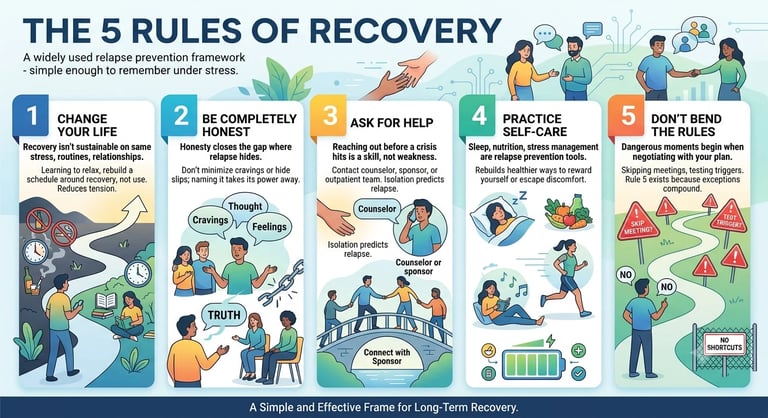
The "5 Rules of Recovery" is a widely used relapse prevention framework in outpatient and clinical settings because it's simple enough to remember under stress - which is exactly when it's needed most.
Recovery isn't sustainable if daily life still runs on the same stress, routines, and relationships that fueled substance use. Learning to relax and rebuild a schedule around recovery - not around use - reduces the tension that so often precedes relapse.
Honesty with yourself and your support network closes the gap where relapse hides. Minimizing cravings or hiding a slip gives it room to grow; naming it out loud takes its power away.
Reaching out - to a counselor, sponsor, or outpatient team - before a crisis hits is a skill, not a weakness. Isolation is one of the most reliable predictors of relapse.
Sleep, nutrition, and stress management aren't optional extras; they're relapse prevention tools. Many people used substances to reward themselves or escape discomfort - self-care rebuilds healthier ways to do both.
The most dangerous moment in recovery is often when someone starts negotiating with their own plan - skipping "just one" meeting, testing "just one" trigger environment. Rule five exists because exceptions compound.
A relapse prevention plan turns intention into action. Outpatient counselors typically help patients build one across four components:
List every situation, emotion, and person connected to past use, then rank them by intensity. This isn't a one-time exercise - triggers shift as life changes.
Warning signs show up before cravings do: isolating from friends, skipping therapy sessions, romanticizing past use, or neglecting routines. Catching these early turns a potential relapse into a manageable lapse.
For each trigger, write the actual action you'll take - not a vague intention. "Call my sponsor" is a plan; "try to stay calm" is not.
A relapse prevention plan that lives in a drawer doesn't help at 11 p.m. on a hard night. Keep it on your phone, share it with your outpatient team, and update it as circumstances change.
"Coping skills are the tools you reach for instead of a substance — and like any skill, they only work if you've practiced them before you need them."
Coping skills to prevent relapse fall into a few evidence-backed categories:

Just five to ten minutes of daily mindfulness practice has been shown to reduce cravings and improve emotional regulation (Source: Power of Recovery / clinical literature on mindfulness-based relapse prevention). Deep breathing and grounding techniques give the nervous system an alternative to the fight-or-flight response that often precedes a craving. For a deeper dive, see our guide on mindfulness and meditation for lasting sobriety.
Regular exercise releases endorphins that improve mood and reduce cravings, and it gives structure to hours that substance use once filled. Explore sober weekend activities that incorporate movement and fun.
Writing down thoughts and feelings surfaces patterns before they become crises — many outpatient programs use structured journaling as homework between sessions.
CBT helps patients recognize the specific thoughts that precede a lapse — "I've earned this," "one won't hurt" — and interrupt them with a rehearsed alternative response.
A support call is a coping skill, not a last resort. Building the habit of calling before a crisis, not during one, is what separates a lapse from a relapse. Read our 7 steps to addiction recovery for more on building support structures.
Relapse prevention activities work because they replace the time, structure, and emotional function that substance use used to occupy.
Structured daily routines — consistent wake times, meals, and sleep schedules reduce the decision fatigue that leads to risky choices
Peer support meetings — AA, NA, or SMART Recovery groups provide accountability and shared experience; SAMHSA research confirms peer support significantly improves long-term recovery outcomes (Source: SAMHSA)
Creative and physical hobbies — art, music, hiking, or team sports fill the reward gap left by substance use
Volunteering — giving back rebuilds purpose and self-worth, both frequently damaged during active addiction
Family or group therapy sessions — repairing relationships strengthens the support system that protects against isolation
Regular check-ins with an outpatient counselor — ongoing clinical support catches warning signs before they escalate
Even motivated patients undercut their own progress in predictable ways:
Treating the plan as a one-time document. Triggers and life circumstances change; a plan written in week one of treatment needs revisiting throughout recovery.
Isolating after early success. Feeling stable often leads people to skip meetings or therapy — exactly when structure matters most.
Ignoring lapses instead of addressing them. A single slip, caught and processed with a counselor, rarely becomes a full relapse. Hidden or ignored, it often does.
Relying on willpower alone. Recovery research consistently shows that structured coping skills and support systems outperform willpower-only approaches — because cravings are a physiological response, not just a mental one.
Skipping professional support once things feel "fine." Continued therapy and periodic clinical check-ins are protective even after the highest-risk window has passed.

A 34-year-old warehouse worker in the Bremerton area entered outpatient treatment for alcohol use disorder after two prior attempts at sobriety ended in relapse within the first three months.
Both previous relapses followed the same pattern — high stress at work, isolation from friends who didn't drink, and no written plan for high-risk evenings.
Working with an outpatient counselor, the client built a relapse prevention plan built around identified triggers (end-of-shift stress, weekend isolation), scheduled twice-weekly IOP group sessions, added a 10-minute breathing practice before driving home, and set a standing accountability call with a sponsor every Friday evening — historically the highest-risk window.
Eighteen months later, the client has maintained sobriety through two high-stress life events (a layoff scare and a family loss) by using the written plan rather than improvising in the moment. One early warning sign — skipping two group sessions in a row — was caught by the outpatient team and addressed before it became a lapse.
The lesson: A relapse prevention plan only works if it accounts for the specific moments that failed before. Generic advice doesn't hold up under real stress; a plan built from personal relapse history does.
Outpatient treatment in Bremerton and greater Kitsap County comes with a specific reality: patients return each evening to the same neighborhoods, job pressures, and, in many cases, the same social circles connected to past use. That makes local, practical relapse prevention planning essential — not generic advice, but a plan built around real Bremerton routines, commute stress, and available community resources.
Cascadia Addiction Treatment Services in Bremerton builds relapse prevention directly into outpatient care through cognitive-behavioral therapy, contingency management, motivational interviewing, and individual relapse prevention planning — so patients leave every session with tools they can use that same day, not just concepts to remember later. For patients balancing work, family, and treatment, that day-to-day practicality is often the difference between a plan that gets used and one that gets forgotten.
Relapse affects 40–60% of people in recovery — it's a predictable part of the process, not a personal failure.
Risk peaks in the first six months after treatment, making early relapse prevention planning critical.
The 5 Rules of Recovery (change your life, be honest, ask for help, practice self-care, don't bend the rules) offer a simple, memorable framework.
A written relapse prevention plan should include trigger maps, warning signs, specific coping responses, and emergency contacts.
Coping skills like mindfulness, exercise, journaling, and CBT techniques work best when practiced before they're needed.
Isolation and skipping support routines are two of the most common precursors to relapse.
Outpatient patients benefit from relapse prevention plans built around their specific daily environment — not generic templates.
Relapse prevention strategies in addiction recovery aren't about eliminating every risk — that's not realistic, and it's not the goal. They're about building a plan specific enough to hold up on the hardest night, whether that's a stressful shift, a family conflict, or the quiet moment when old habits start to feel tempting again. The 5 Rules, a written plan, practiced coping skills, and a support system that knows to check in before a crisis — together, these turn relapse from something that happens to you into something you're prepared for.
If you're an outpatient patient in Bremerton working through this right now, you don't have to build that plan alone — our outpatient relapse prevention services are here to help.
At Cascadia Bountiful Life, we provide outpatient and intensive outpatient addiction treatment services in Bremerton, WA. We accept most major insurance plans including Apple Health (Medicaid), Molina, and Community Health Plan of Washington. Your first consultation is free and strictly confidential — and you don't need a referral.
Monday–Thursday, 9 AM–5 PM | In-office & telehealth available